Thursday, 3 October 2019

Budapest — Hungarian State Opera House

The weather was a bit chilly so I decided to view an indoor attraction, the Hungarian State Opera House. It was in fact walking distance from my lodgings in Király Street. It even has a metro stop named after it.
Unlike most stations on other lines, this station is just beneath the street with one flight of steps to reach it.
The building itself was under renovation so performances had been moved elsewhere, but tours of the interior, except for the hall itself, were still running.

Tour sessions were in the afternoon so I bought a ticket for later. However I will combine the photos of the first visit and the afternoon tour to keep this post on theme.
The building is neo-renaissance and the interiors are richly decorated.
Construction was supported by the city of Budapest and Emperor Franz-Joseph I. Later during the tour, the guide mentioned that a proviso of the imperial support was that it could not exceed the Vienna State Opera in grandeur. It was a favourite of Sisi.
Paintings on the ceiling.
Gilded arches and marble.
Mosaic floor.
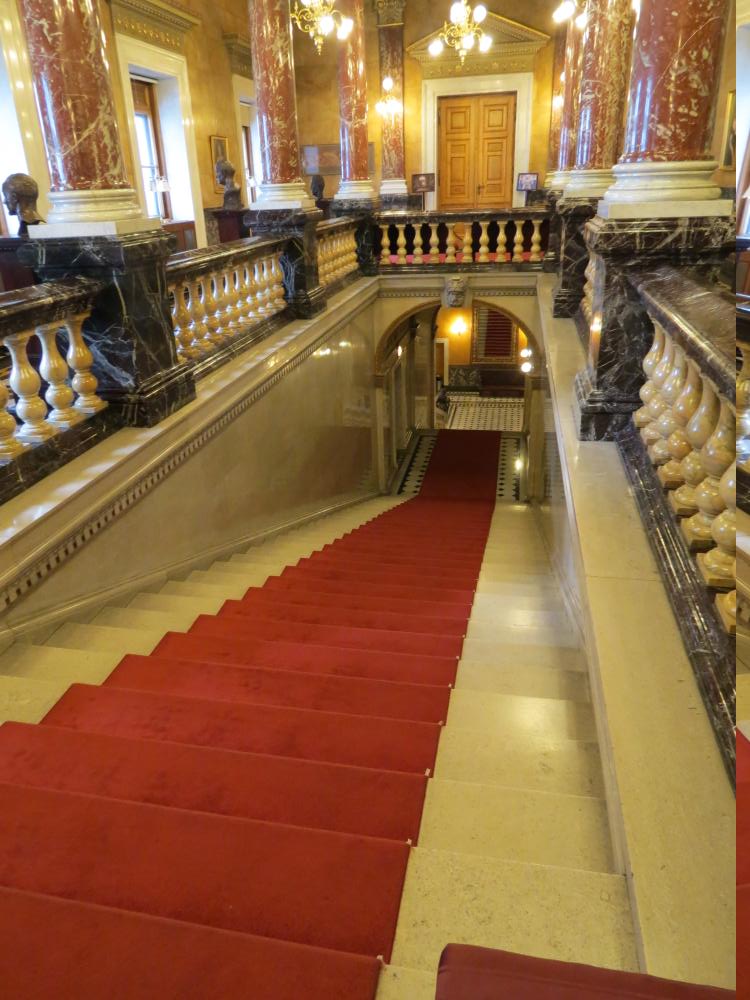
Later that afternoon, waiting in queue to ascent the staircase.
We were divided up into 3 groups each headed by a guide.
The bar where drinks are served.
The walls of the bar.
Large mirror.
Red carpeting.
The opera hall being under renovation we were only given glimpses of it from the antechamber.
On the main staircase behind the guide, they were setting up for a small performance to top our tour.
The accompanist played incidental music while we assembled.
The singers performed 3 pieces for us. The first was Quando me'n vo' a.k.a Musetta's Waltz from La Bohème.
Her fellow performer arrives. I'm guessing that they were students or understudies, certainly not famed performers.
I forget what the second piece was but the last was a duet from The Magic Flute.
A rousing climax and that was the end of the tour.

Wednesday, 2 October 2019

Szentendre

Szentendre is a easy day trip from Budapest, and in fact can be reached by local trains, with one connection. The last leg requires a supplementary ticket, and with inspectors on the prowl, I took no chances.
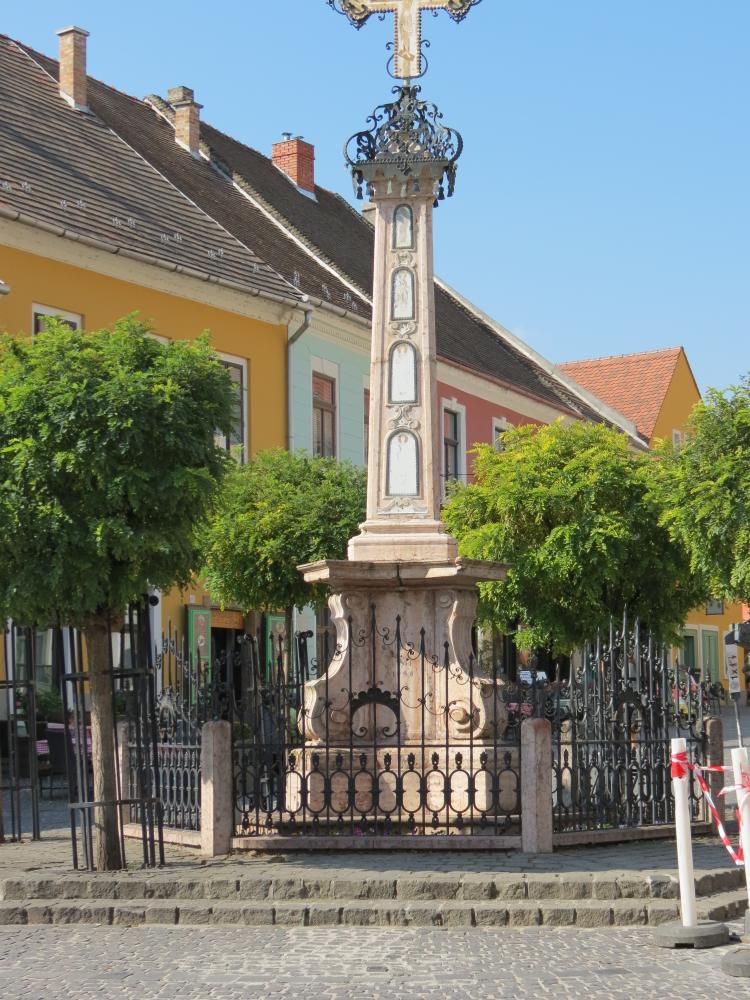
Szentendre is situated opposite an island of the same name separating the Szentendre and main branches of the Danube after it has squeezed through the Danube Bend. It features historic architecture and artists' galleries, so is popular with visitors, but it's also touristy, with stalls chock full of souvenirs, trinkets, that sort of thing. Anyway it was beautiful weather to be out so that didn't bother me.
Charlotte appears to be a paper store.
Pretty street decorations with the Blagovestenska Orthodox Church in the background.
A closer look at the lampshades.
A traffic island at Fö Tér.
Bubble tea has reached even here, the Frutta Bar.
No matter which fork of the road you take, you have to pass temptation in the form of Centrum Fagyizó confectionery.
Trinket (actually Bogdányi) Street.
But colourful shades.
That old manual sewing machine takes me back.
The bank of the Szentendre branch of the Danube with Szentendre Island opposite. There are a couple of boat runs from Budapest per day.
Very relaxed local.

From the time gap to the next photo I think I took a break to have a beer at a riverside restaurant.
At the tiny Szántó Jewish Memorial House and Temple, possibly the smallest synagogue in the world, a tablet commemorates the Jewish families who were deported. The Nazis invaded Hungary in March 1944 and started deportations in May, ending 9 July, the date on the tablet. The losses were grievous. Close to ½ million Jews, Hungarian and from other countries, were deported. The top of the tablet quotes the 6th commandment: Do not kill.
Saint John the Baptist's Parish Church on a hill.
From here one has an overview of Szentendre.
Pigeons taking advantage of Blagovestenska Orthodox Church.
A great survivor.
The river bank.
Back at street level. Városháza means town hall.
I had a lángos at Álomlángos, which is a small shop but reputed to make some of the best exemplars of this snack. It's on a lane going up the hill.
After that I needed refreshment, so...
And the shop that supplied me.
I must have been tired so rested in the afternoon after returning to Budapest as there is only one more picture for this day, and it's of my dinner of Hungarian goulash. It was very filling since I also ordered pita and hummus.

Tuesday, 1 October 2019

Pécs panorama

Click on the thumbnail for the full sized version.


The main square which of course isn't curved like that.

Pécs 2 — old city

I looked through a couple of city malls for a suitable lunch place, but it was mostly fast food you could get anywhere. I ended up in the old city again where I spotted a restaurant offering the dish of the day with soup. This turned out to be a cold fruit soup. Apparently it's often found in central European countries and popular during summer because it's refreshing. I had something similar in Košice.
This is the eatery I went to. The main dish was nothing special but it was filling.
The post office around the corner.
Kávéház is of course, coffee house.
I treated myself to an afternoon coffee and cake.
One last look at Szchényi Tér and it was back to the pension to collect my bag and head for the train station.

Uneventful hours later I was back in Budapest but this time my accommodation was in Pest, and in a fairly central location.


Pécs 2 — Tettye

Breakfast was served in a cozy dining room. The pleasant young staff seemed to be training in hospitality.

My train wasn't until early afternoon so I left my luggage with reception and went for a walk to Tettye (page in Hungarian, use Translate) which is in the hills backing Pécs and has a great view over the city and plains.
But I'm getting ahead of myself. First I have to get there.

I found the walking trail up the hill. A water channel wheel ran alongside for a while.
Approaching the ruins and public area.
Street furniture and fountain.
Detail of the fountain.
The ruins and an iron viewing platform.
A school group was on an excursion.
The street furniture from above.
The access road and a small vineyard.
The stone blocks are more modern.
As is this outdoor art.
A portal in the ruins.
Detail of the stonework.

There wasn't much information on site, even in Hungarian, about the ruins. I guess it doesn't attract much attention from tourism and locals regard it as just part of their heritage. The Hungarian Wikipedia page seems to have the most information.
Another part of the complex.
The access road and beyond, the plains to the south.
Sculpture celebrating Pécs Capital of Culture in 2010 project.
I liked this tree hollow.
One last look.

There was a wine garden on site, but I didn't feel like having anything this early in the day so decided to descend to the city to look for lunch before leaving Pécs.